When should you choose PageUtil or manual Apache configuration?
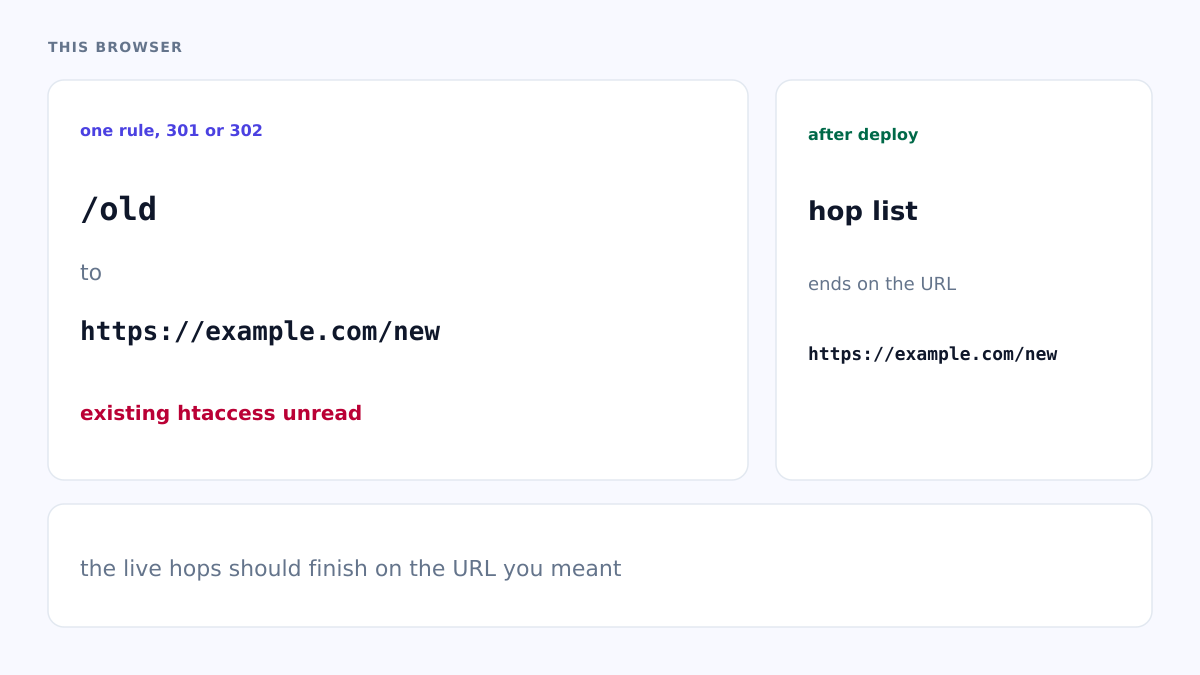
Apache documents several redirect and rewrite mechanisms with different contexts. PageUtil’s generator does not read the existing .htaccess file. A generated rule therefore needs to be placed deliberately within the server’s actual configuration and tested with nearby paths.
| Requirement | PageUtil | manual Apache configuration |
|---|---|---|
| Simple path move | Generate a focused snippet | Write the equivalent Apache rule |
| Complex conditions | Review the surrounding configuration | Author context-specific rules |
| Proof | Observe deployed responses | Observe deployed responses |
Is PageUtil free, and what else do you need?
PageUtil htaccess Redirect Generator is free to use without creating a PageUtil account. This covers the tool’s supported workflow and outputs; its technical limits still apply.
Apache hosting and configuration access remain separate. Compare the time needed to author and review a snippet with the time required to test it in the actual server configuration.
Compare the complete task, including preparation, review and destination access. Consult the linked provider documentation for current terms; no unverified competitor price is assumed here.
About PageUtil and its free tools
A worked example to test the choice
An old /pricing page should move to /plans. An existing hostname rule already redirects www to the preferred host. Review the order so the new path change reaches the final URL without an unnecessary intermediate hop or a loop back to the old address.
How do you run the PageUtil workflow?
Open htaccess Redirect Generator.
Record the intended source, destination and temporary or permanent status. Generate the snippet or edit the corresponding Apache rule in a working copy. Review the context and existing rule order, deploy through the normal process and test the source, destination and relevant query strings.
For the detailed procedure and interpretation, read How to write an Apache redirect rule.
What are the practical limits?
A permanent redirect may be cached by browsers. Server configuration, rewrite context and application routing can change the observed outcome. A valid snippet alone cannot establish compatibility with the rest of the site.
What should you verify before using the result?
Check the emitted status, Location header and final response. Test a path that should remain unaffected and retain the previous configuration so an unintended redirect can be corrected promptly.
Sources and comparison scope
Prepared on 18 November 2026 using the current PageUtil workflow and the linked official documentation, checked on 17–18 November 2026. The example is illustrative. Competitor descriptions are based on published documentation; this article does not report a comparative performance benchmark.
Continue troubleshooting
- How to write an Apache redirect rule
- Screaming Frog Alternative for Comparing Sitemaps
- PageUtil vs Screaming Frog for Redirect Checks
- PageUtil vs Search Console for Indexing Report Comparisons
- PageUtil vs IndexNow Integrations for URL Submission
- PageUtil vs Manual Editing for Robots TXT Rules
- PageUtil vs Cloudflare Bulk Redirect CSV Import
- PageUtil vs Vercel Redirect Configuration Checks
- PageUtil vs Cloudflare Pages Header Configuration
- PageUtil vs Webflow CMS for CSV Migration Checks
Related tools
Frequently asked questions
Does the generator inspect my .htaccess file?
No. Review the generated snippet against the existing server, application and CDN rules yourself.
Should I use 301 or 302?
Use the status that matches the intended permanence and request behavior. Verify the receiving client and caching implications.
Why can a correct-looking rule loop?
Another rule may reverse its host, scheme or path transformation. Inspect the complete deployed sequence.
Should I test query strings?
Yes. Verify meaningful query parameters and nearby paths according to the intended redirect contract.
Is the PageUtil tool free to use?
Yes. PageUtil htaccess Redirect Generator is free to use without a PageUtil account. Apache hosting and configuration access remain separate. Compare the time needed to author and review a snippet with the time required to test it in the actual server configuration.