When should you choose PageUtil or Chrome DevTools?
A browser can remove well-known credential headers while leaving business data in URLs, request bodies, response bodies or custom headers. The useful comparison is which locations were examined and what the chosen policy changes. A HAR can also be incomplete, so preserve enough diagnostic structure to explain the reported failure.
| Requirement | PageUtil | Chrome DevTools |
|---|---|---|
| At capture | Review the exported HAR in PageUtil | Export sanitized HAR from Network |
| Application data | Inspect supported secret locations and policies | Inspect values remaining after browser sanitization |
| Final evidence | Review transformed file before sharing | Review exported file before sharing |
Is PageUtil free, and what else do you need?
PageUtil HAR File Sanitizer is free to use without creating a PageUtil account. This covers the tool’s supported workflow and outputs; its technical limits still apply.
Chrome DevTools provides a capture and export workflow. Budget time for inspecting the resulting archive in either route, because application-specific secrets can appear outside familiar authentication fields.
Compare the complete task, including preparation, review and destination access. Consult the linked provider documentation for current terms; no unverified competitor price is assumed here.
About PageUtil and its free tools
A worked example to test the choice
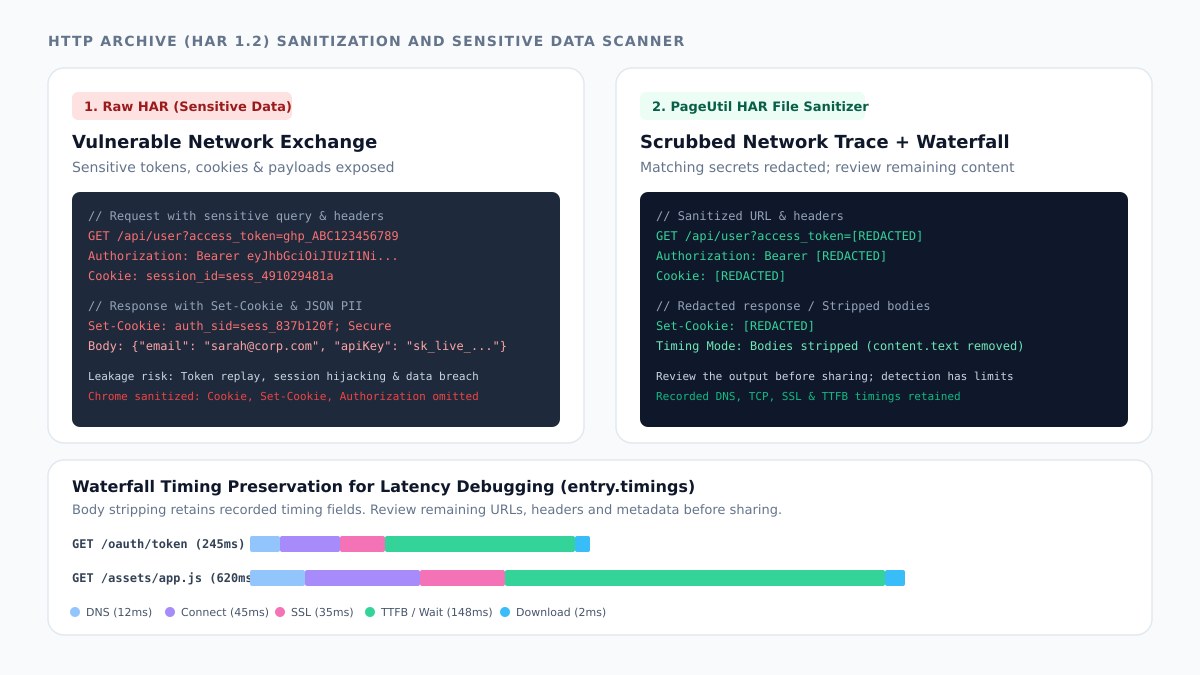
A request URL contains ?api_key=example-secret while its Authorization header is absent. Removing the standard header does not remove the query value. A JSON response might also contain a customer email or address. Inspect the request and response locations that are relevant to your application.
How do you run the PageUtil workflow?
Open HAR File Sanitizer.
Export a sanitized recording from Chrome and keep a private original. Load the HAR into PageUtil, review detected fields and the selected sanitization policy, and inspect the before-and-after evidence. Export the reviewed candidate. Search the final file for known test secrets and sensitive field names before attaching it to a ticket.
For the detailed procedure and interpretation, read How to sanitize HAR files and remove sensitive data.
What are the practical limits?
A rule-based scan cannot identify every confidential value in arbitrary application data. An encoded or unusual field can require manual review. Redaction can also remove evidence needed to reproduce a failure, so explain the transformations to the recipient.
What should you verify before using the result?
Confirm that status codes, timings and the relevant request sequence still explain the problem. Share the reviewed candidate through the intended support channel, retaining the original only according to your organization’s handling requirements.
Sources and comparison scope
Prepared on 18 November 2026 using the current PageUtil workflow and the linked official documentation, checked on 17–18 November 2026. The example is illustrative. Competitor descriptions are based on published documentation; this article does not report a comparative performance benchmark.
Continue troubleshooting
- How to sanitize HAR files and remove sensitive data
- regex101 Alternative for Testing Regular Expressions
- PageUtil vs regex101 for Google Search Console and GA4 Regex
- Curious Concept Alternative for Formatting JSON
- PageUtil vs CyberChef for Formatting XML
- JWT.io Alternative for Decoding Token Claims
- Diffchecker Alternative for Comparing Text Lines
- Crontab Guru Alternative for Cron Schedule Checks
- PageUtil vs Dependabot for Dependency Group Rule Testing
- PageUtil vs Chrome for Manifest V3 Validation
Related tools
Frequently asked questions
Does Chrome sanitized HAR remove every secret?
It omits specified sensitive headers. Application-specific secrets and personal data can remain elsewhere in the recording.
Can an API key be present without an Authorization header?
Yes. Applications can put credentials in query parameters, custom headers or request bodies. Review the actual schema.
Does sanitization keep the recording useful?
It should retain the diagnostic structure you need, but a policy can remove relevant values. Review the result and document the changes.
Should I share the original HAR for comparison?
Share only the material approved for the recipient. Keep the original privately when needed to investigate or verify the sanitization.
Is the PageUtil tool free to use?
Yes. PageUtil HAR File Sanitizer is free to use without a PageUtil account. Chrome DevTools provides a capture and export workflow. Budget time for inspecting the resulting archive in either route, because application-specific secrets can appear outside familiar authentication fields.