When should you choose PageUtil or Dependabot?
GitHub documents grouping options in dependabot.yml. A broad pattern can absorb packages intended for a narrower group, and excluded names can remain outside the planned batch. Review the exact dependency inventory and update context instead of testing one reassuring package name.
| Requirement | PageUtil | Dependabot |
|---|---|---|
| Rule review | Supplied configuration and dependency names | dependabot.yml options |
| Update discovery | Provide representative input evidence | Inspect manifests and available updates |
| Execution | Review predicted grouping | Create eligible update pull requests |
Is PageUtil free, and what else do you need?
PageUtil Dependabot Group Rule Tester is free to use without creating a PageUtil account. This covers the tool’s supported workflow and outputs; its technical limits still apply.
Repository access, Dependabot availability and update execution remain separate from local rule testing. Include the effort of maintaining configuration and reviewing actual update pull requests.
Compare the complete task, including preparation, review and destination access. Consult the linked provider documentation for current terms; no unverified competitor price is assumed here.
About PageUtil and its free tools
A worked example to test the choice
Suppose the first group is broad with patterns ["*"], and a later types group uses patterns ["@types/*"]. An eligible @types/node update matches both. Dependabot assigns it to broad because the first matching group wins. Place the specific group first if the intended result is a separate types batch.
Now add @types/node to the types group’s exclude-patterns. That exclusion prevents membership in types; it does not exclude the package from all updates. An eligible update may match the later broad group. Test both configurations against the same supplied update so the effect of precedence and exclusion is visible.
How do you run the PageUtil workflow?
Open Dependabot Group Rule Tester.
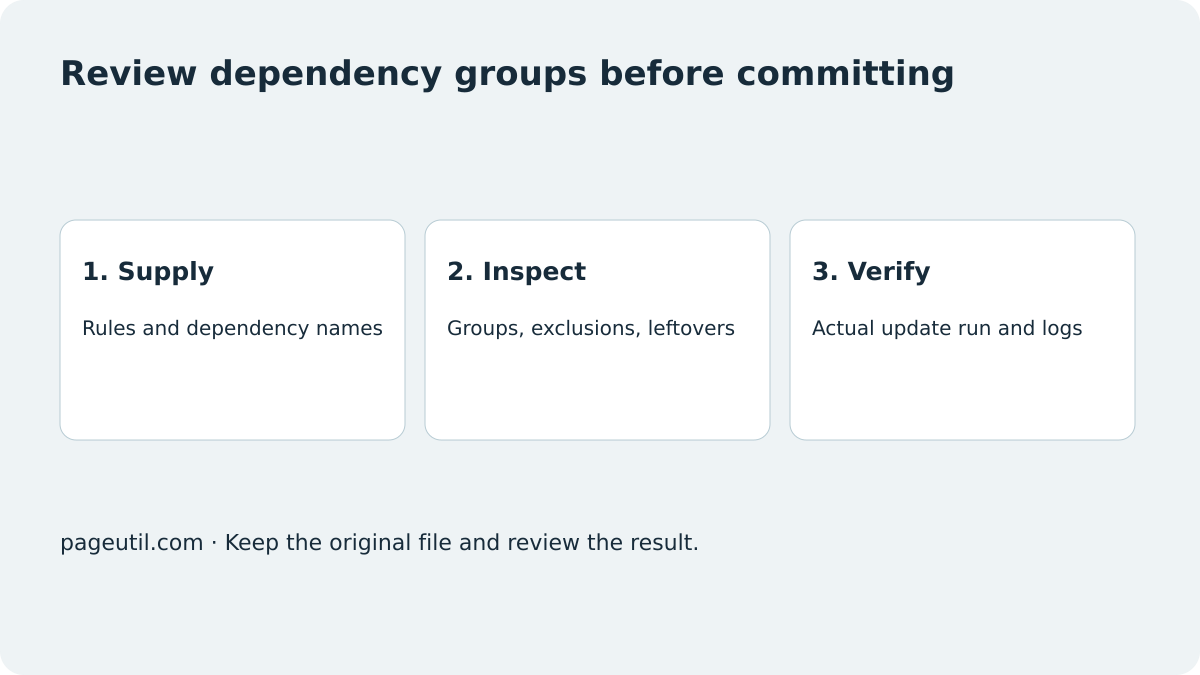
Provide the configuration and representative dependency inventory to the tester. Review matching groups, exclusions and unmatched entries. Check rule order and the relevant ecosystem or update context against GitHub’s documentation. Commit the reviewed configuration through the repository’s normal process and inspect the next Dependabot run.
What are the practical limits?
The tester cannot determine every available release, lockfile constraint, registry credential or security-update decision. A local match is evidence about supplied rules and names, while live pull requests depend on repository state.
What should you verify before using the result?
Compare the next update run with the predicted grouping and investigate differences using Dependabot logs. Keep the inventory and configuration version used in the preview so the comparison is reproducible.
Sources and comparison scope
Prepared on 18 November 2026 using the current PageUtil workflow and the linked official documentation, checked on 17–18 November 2026. The example is illustrative. Competitor descriptions are based on published documentation; this article does not report a comparative performance benchmark.
Continue troubleshooting
- regex101 Alternative for Testing Regular Expressions
- PageUtil vs regex101 for Google Search Console and GA4 Regex
- Curious Concept Alternative for Formatting JSON
- PageUtil vs CyberChef for Formatting XML
- JWT.io Alternative for Decoding Token Claims
- Diffchecker Alternative for Comparing Text Lines
- Crontab Guru Alternative for Cron Schedule Checks
- PageUtil vs Chrome DevTools for HAR Sanitization
- PageUtil vs Chrome for Manifest V3 Validation
Related tools
Frequently asked questions
Does a local group match guarantee a pull request?
No. Available versions, constraints, update type and repository configuration determine whether Dependabot proposes an update.
Why test an excluded package?
It verifies that the exclusion actually changes the intended group membership. Positive examples alone miss boundary errors.
Can group order matter?
Yes. When a dependency matches multiple group rules, Dependabot places it in the first matching group. Put a specific group before a catch-all when that is your intended policy. An exclusion removes a dependency from that group, so also inspect whether it matches a later rule.
Is this a replacement for Renovate or Dependabot automation?
It provides a local configuration review. Repository update discovery and pull-request automation still run through the selected bot.
Is the PageUtil tool free to use?
Yes. PageUtil Dependabot Group Rule Tester is free to use without a PageUtil account. Repository access, Dependabot availability and update execution remain separate from local rule testing. Include the effort of maintaining configuration and reviewing actual update pull requests.