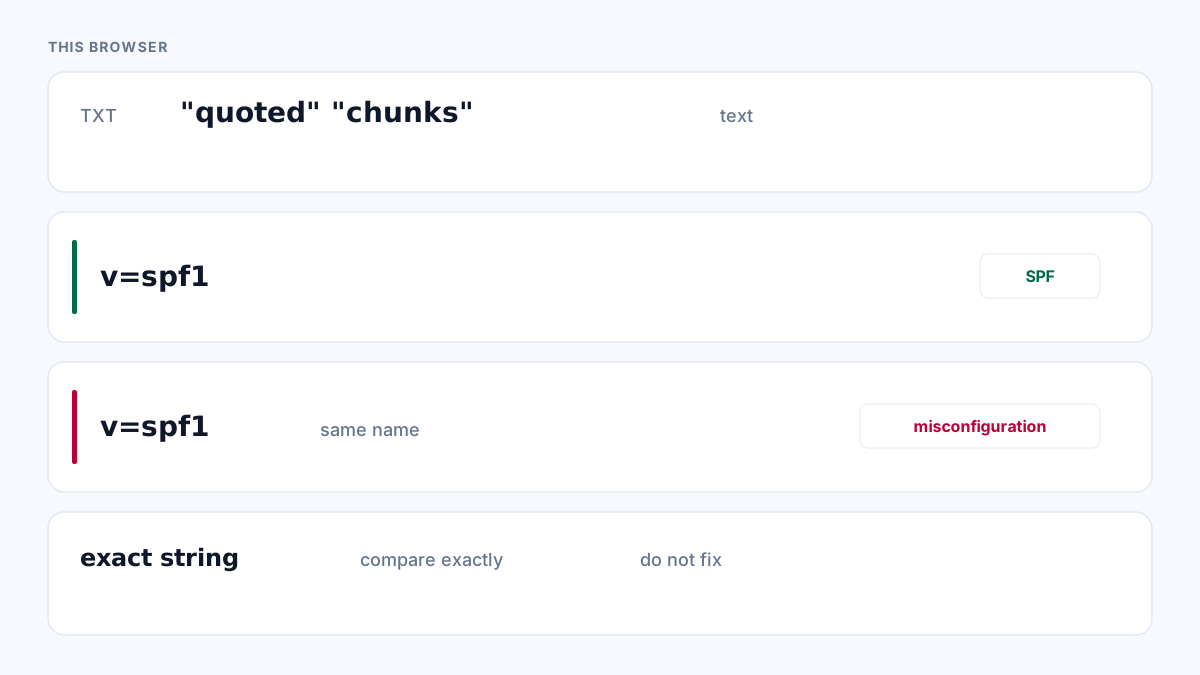
Distinguish duplicate policies from split text
Look up TXT for the exact domain used by the envelope sender. The visible From address may differ from that identity. A subdomain has its own policy lookup; the root domain’s policy does not automatically apply to every subdomain.
The example below has two separate SPF records at the same owner name. A receiver does not choose the more permissive one. By contrast, multiple character strings inside one TXT resource record are concatenated as one record; that is not automatically a duplicate policy.
example.com TXT "v=spf1 include:_spf.vendor-a.example -all"
example.com TXT "v=spf1 include:_spf.vendor-b.example ~all"

# Two separate SPF policies: review and reconcile.
# The vendor names above are illustrative, not deployable settings.
Inventory legitimate senders before replacing the policy
Identify every system that sends envelope mail using this domain: staff mail, transactional services, support tools and marketing systems. Obtain each provider’s current SPF instructions directly. Do not copy an include from an unrelated domain or an old blog example.
Compose one reviewed policy that covers the legitimate systems. The include mechanisms can cause additional DNS lookups; SPF has an evaluation lookup limit. PageUtil shows TXT answers but does not recursively evaluate SPF or calculate its full lookup budget.
Keep the intended final qualifier policy explicit. Replacing -all with +all is not a fix: +all authorizes arbitrary senders. Consider staged testing and inspect delivery evidence before tightening a policy.
| Observed text | Meaning |
|---|---|
| Two separate v=spf1 records at the same owner | Conflicting SPF policy records |
| One SPF record split into quoted character strings | May be one valid logical policy |
| SPF plus a vendor ownership-verification TXT | Different purposes; not inherently conflicting |
| One root policy plus one subdomain policy | Different owner names; inspect the actual mail identity |
Verify DNS and a real delivery separately
Save the previous record, update the authoritative zone, and allow for cached answers. Query TXT again after the relevant TTL. Confirm there is one SPF policy at the intended owner, not merely one line in the provider’s editing interface.
Then send a controlled test message and inspect Authentication-Results at the receiving system. DNS visibility alone does not prove that a message used the expected envelope domain, passed SPF or satisfied DMARC alignment.
If delivery still fails, use the bounce code and message headers to choose the next check. SPF does not confirm mailbox existence, override content filtering or guarantee delivery.
References
Use the linked specifications and product documentation to check behavior in your own environment.
Continue troubleshooting
Related tools
Frequently asked questions
Are all multiple TXT records invalid?
No. The conflict is multiple SPF policies at one owner name, not unrelated TXT records.
Can PageUtil fully validate an SPF policy?
No. DNS Lookup displays answers and does not perform recursive SPF evaluation.
Does an SPF pass guarantee inbox delivery?
No. Mailbox state, authentication alignment, filtering and server policy still affect delivery.