Work through a concrete cache timeline
Suppose a resolver cached 192.0.2.10 at 10:00 with a TTL of 3600 seconds. You update the authoritative A record to 192.0.2.20 at 10:10. That resolver can still return its cached value until roughly 11:00 under ordinary caching behavior.
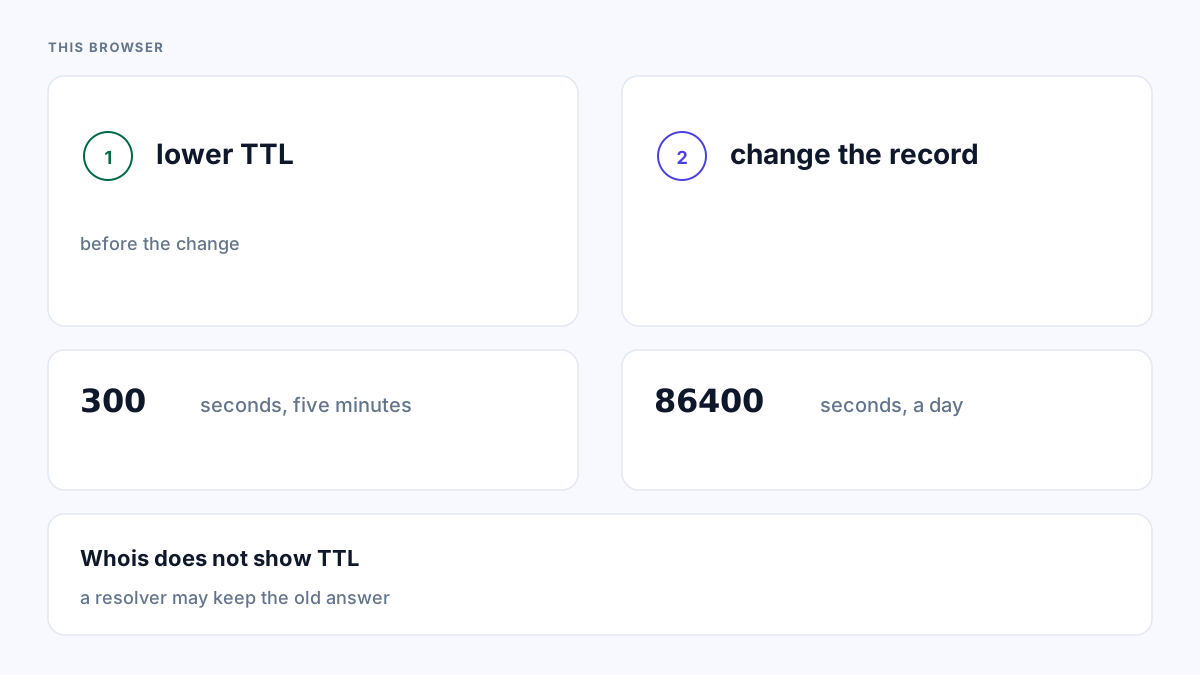
If you lower the authoritative TTL at 10:10, the previously cached one-hour answer does not learn about that edit immediately. Lower the TTL ahead of a planned cutover and allow the previous TTL window to pass. Serve-stale policies and failures can complicate simple timelines.
| Time UTC | Action | Possible recursive answer |
|---|---|---|
| 10:00 | Resolver caches old A, TTL 3600 | 192.0.2.10 |
| 10:10 | Authoritative A changed | 192.0.2.10 remains cached |
| 11:00 or later | Cache expires and refresh succeeds | 192.0.2.20 |
Verify the zone and every relevant record type
Check NS answers and compare them with the provider where you edited the zone. Whois Lookup can show registration/delegation clues through RDAP, but it is not a substitute for an authoritative DNS query.
Query the authoritative server directly from your own terminal when needed. PageUtil does not offer resolver selection or global propagation coverage. The documentation IPs in this example are placeholders, not instructions to edit a real zone.
Check AAAA as well as A. A browser may use IPv6 while you are looking only at IPv4. For an alias, follow each CNAME target with a separate query because PageUtil does not follow CNAMEs automatically. Cloudflare-proxied records can intentionally return edge IPs instead of your origin IP.
# Replace the reserved example name with a domain you administer.
dig NS example.com
dig @ns1.example.net example.com A
dig example.com AAAA
dig www.example.com CNAME
Separate public DNS from local and application state
If authoritative and recursive answers agree on the new address, inspect your device resolver, VPN, hosts file and browser connection reuse. A private network can intentionally resolve the same name differently. Flushing your laptop’s cache does not flush an ISP resolver.
Keep a short evidence table containing queried name, record type, resolver, answer, TTL and UTC time. Compare the same name and type before drawing a conclusion. Avoid repeatedly changing the zone: each edit makes the migration harder to reason about.
Retest the application after DNS is correct. An old certificate, wrong virtual host or cached page can look like an old-server problem even when the connection reaches the intended IP.
References
Use the linked specifications and product documentation to check behavior in your own environment.
Continue troubleshooting
Related tools
Frequently asked questions
Does PageUtil check DNS from every country?
No. It queries Cloudflare’s public recursive resolver through DNS over HTTPS.
Will lowering TTL clear existing caches?
No. Existing cache entries retain the lifetime obtained when they were stored.
Can an AAAA record explain different behavior?
Yes. IPv6-capable clients can use AAAA even when the A record is correct.