When should you choose PageUtil or dmarcian?
dmarcian provides a DMARC Record Wizard, while PageUtil offers policy and reporting controls in its local generator. The important decision is the intended policy and the operational destination for reports. A reporting address should be controlled and monitored by the people investigating authentication results.
| Requirement | PageUtil | dmarcian |
|---|---|---|
| Drafting | Policy and reporting controls | DMARC Record Wizard |
| Publication | Publish and verify the TXT record | Publish and verify the TXT record |
| Enforcement decision | Use alignment and sender evidence | Use alignment and sender evidence |
Is PageUtil free, and what else do you need?
PageUtil DMARC Record Generator is free to use without creating a PageUtil account. This covers the tool’s supported workflow and outputs; its technical limits still apply.
For dmarcian, distinguish the record-building task from report collection, monitoring and support. The operational requirement grows when you need continuous evidence across multiple sending services.
Compare the complete task, including preparation, review and destination access. Consult the linked provider documentation for current terms; no unverified competitor price is assumed here.
About PageUtil and its free tools
A worked example to test the choice
A domain has several approved senders and begins collecting aggregate reports. One service authenticates successfully under its own domain but lacks alignment with the organization’s visible From domain. Review that service’s configuration before increasing enforcement, because policy syntax cannot repair an unaligned sending setup.
How do you run the PageUtil workflow?
Open DMARC Record Generator.
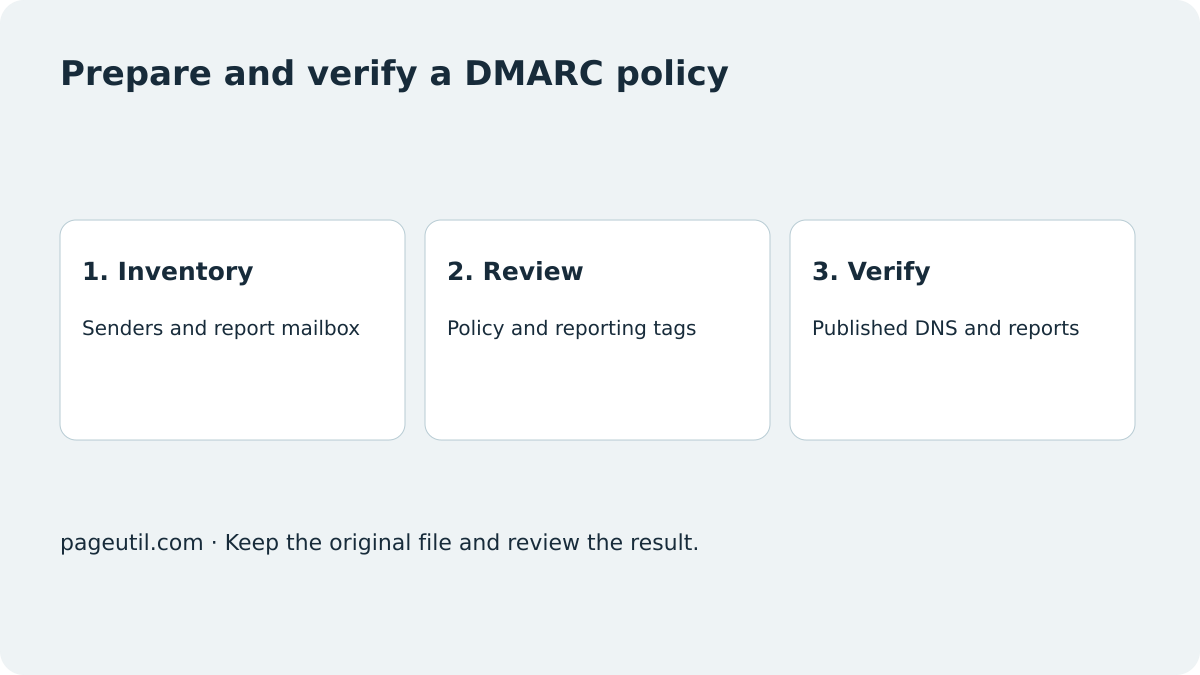
Inventory legitimate senders, choose the intended policy and reporting destination, and review the generated TXT value. Publish it at the correct _dmarc name in the authoritative DNS zone. Verify the resulting record and inspect reports and trusted receiver results from representative sending paths.
What are the practical limits?
A generator cannot prove that every legitimate sender aligns or that a reporting mailbox is monitored. Duplicate policy records and provider-specific DNS entry conventions can also affect publication. Confirm current standards and provider behavior for advanced tags before depending on them.
What should you verify before using the result?
Record the policy change date and compare equivalent report windows. Investigate missing senders and failures using their actual message evidence, then make the next policy decision from that review.
Sources and comparison scope
Prepared on 18 November 2026 using the current PageUtil workflow and the linked official documentation, checked on 17–18 November 2026. The example is illustrative. Competitor descriptions are based on published documentation; this article does not report a comparative performance benchmark.
Continue troubleshooting
- dmarcian XML to Human Alternative for DMARC Reports
- MxToolbox Alternative for Email Header Analysis
- PageUtil vs ZeroBounce for Email List Cleanup
- MxToolbox Alternative for Generating SPF Records
- PageUtil vs MxToolbox for Email Health Checks
- PageUtil vs Google Contacts for Duplicate Contact Cleanup
- PageUtil vs Google Contacts CSV Import Mapping
Related tools
Frequently asked questions
Does p=none mean authentication failed?
No. It is a policy request. Authentication and alignment results determine whether the message passes DMARC.
Does a valid DMARC record prove my senders are configured correctly?
No. Test the legitimate sending paths and inspect alignment evidence from trusted receivers and aggregate reports.
Where is a DMARC record published?
The policy is published as DNS TXT at the appropriate _dmarc name. Follow the DNS provider’s host-field conventions and verify the result.
Should I increase enforcement immediately after generating a record?
Base enforcement on the intended policy and verified legitimate-sender coverage. The generator’s syntax check cannot supply that operational evidence.
Is the PageUtil tool free to use?
Yes. PageUtil DMARC Record Generator is free to use without a PageUtil account. For dmarcian, distinguish the record-building task from report collection, monitoring and support. The operational requirement grows when you need continuous evidence across multiple sending services.