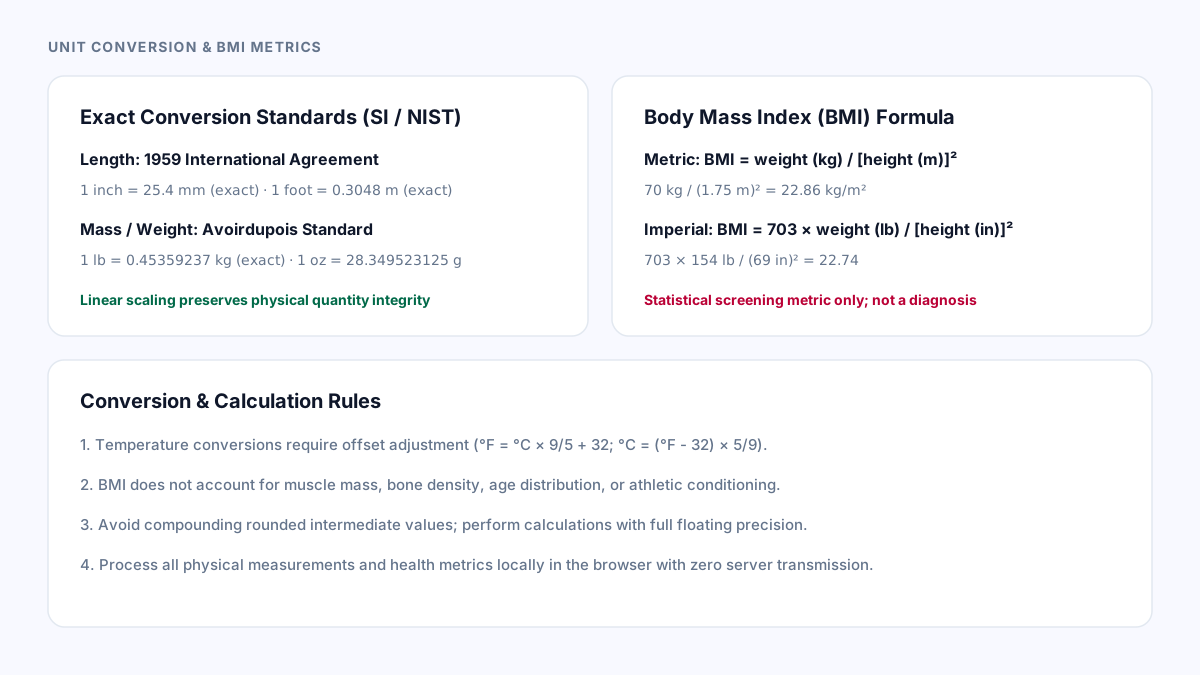
Exact international conversion factors vs approximations
In science and engineering, rounding conversion factors too early introduces cumulative drift that can compromise physical tolerances. Historically, various definitions of the foot, pound, and gallon existed across English-speaking nations until the 1959 International Yard and Pound Agreement standardized exact international values.
Under this agreement, 1 yard is defined as exactly 0.9144 meters, which establishes 1 international inch as exactly 25.4 millimeters (0.0254 meters). Similarly, 1 international avoirdupois pound (lb) is defined as exactly 0.45359237 kilograms.
Using approximations like "1 kg is about 2.2 lbs" or "1 inch is about 2.5 cm" produces unacceptable errors when scaled to industrial manufacturing or aviation. PageUtil’s Unit Converter computes conversions using full floating-point precision based on official NIST and SI specifications.
Temperature scale shifts: affine vs linear conversions
While length, mass, and volume conversions are strictly linear ratios (multiplying by a constant conversion factor), temperature conversion between Celsius and Fahrenheit is an affine transformation requiring both a scale multiplier and an additive zero-point offset.
Because the Fahrenheit scale places the freezing point of water at 32°F and boiling at 212°F (a 180-degree interval), while the Celsius scale places them at 0°C and 100°C (a 100-degree interval), each Celsius degree is equivalent to 1.8 (9/5) Fahrenheit degrees.
To convert Celsius to Fahrenheit, multiply by 9/5 and add 32: °F = (°C × 9/5) + 32. To convert Fahrenheit to Celsius, subtract the 32-degree offset first before multiplying by 5/9: °C = (°F - 32) × 5/9. Omitting parentheses or applying the offset in the wrong sequence is one of the most common programming bugs in unit handling.
// Exact temperature conversion in JavaScript
function convertTemperature(value, fromScale, toScale) {
  if (fromScale === toScale) return value;
  // Convert source to Celsius base
  const celsius = fromScale === "f" ? (value - 32) * (5 / 9) : value;
  // Convert Celsius to target scale
  return toScale === "f" ? (celsius * (9 / 5)) + 32 : celsius;
}
Calculating Body Mass Index (BMI) and formula boundaries
Body Mass Index (BMI) is a standardized screening metric established by Belgian statistician Adolphe Quetelet and adopted by the World Health Organization (WHO) to categorize body mass relative to height in adult populations.
In metric units, the formula is: BMI = weight (kg) / [height (m)]². In imperial units, an adjustment factor of 703 is applied: BMI = 703 × weight (lb) / [height (in)]².
When using BMI Calculator, it is essential to understand that BMI is a general population screening tool, not a diagnosis. The formula evaluates total mass without distinguishing between muscle tissue, bone density, subcutaneous fat, or fluid retention. Athletes with high muscle mass often score in the "overweight" category despite low body fat percentages.
| Classification | BMI Range (kg/m²) | Health Context | Technical Limitations |
|---|---|---|---|
| Underweight | < 18.5 | Possible nutritional deficiency | Does not evaluate metabolic health |
| Normal weight | 18.5 – 24.9 | Standard population baseline | Normal BMI can coexist with high visceral fat |
| Overweight | 25.0 – 29.9 | Elevated mass relative to height | Athletes frequently misclassified |
| Obesity Class I | 30.0 – 34.9 | Increased cardiovascular risk | Population metric only; not a diagnosis |
| Obesity Class II/III | ≥ 35.0 | High clinical health risk | Requires comprehensive medical evaluation |
Dimensional analysis and engineering verification
Before completing engineering specifications or physical construction plans, apply dimensional analysis to verify that units cancel out correctly across conversion steps.
Verify whether liquid volume conversions refer to US customary units or UK Imperial units (for example, a US liquid gallon is 3.785 liters, whereas an Imperial gallon is 4.546 liters). Confirm whether weights refer to avoirdupois ounces or troy ounces (used exclusively in precious metals).
All conversions and BMI evaluations run locally inside your browser sandbox. Personal physical measurements and medical screening figures are never transmitted to any external server.
References
Use the linked specifications and product documentation to check behavior in your own environment.
Continue troubleshooting
Related tools
Frequently asked questions
What is the exact definition of an inch in millimeters?
Under the 1959 International Yard and Pound Agreement, an inch is defined as exactly 25.4 millimeters. This definition is standardized across international engineering and manufacturing.
Why does temperature conversion require an offset?
Temperature conversion is an affine transformation because the zero points do not align. Zero degrees Celsius corresponds to 32 degrees Fahrenheit, requiring a 32-degree addition or subtraction.
Is Body Mass Index a clinical diagnosis of health?
No. Body Mass Index is a statistical population screening ratio, not a diagnosis. It does not measure body fat percentage, muscle mass, or cardiovascular fitness directly.