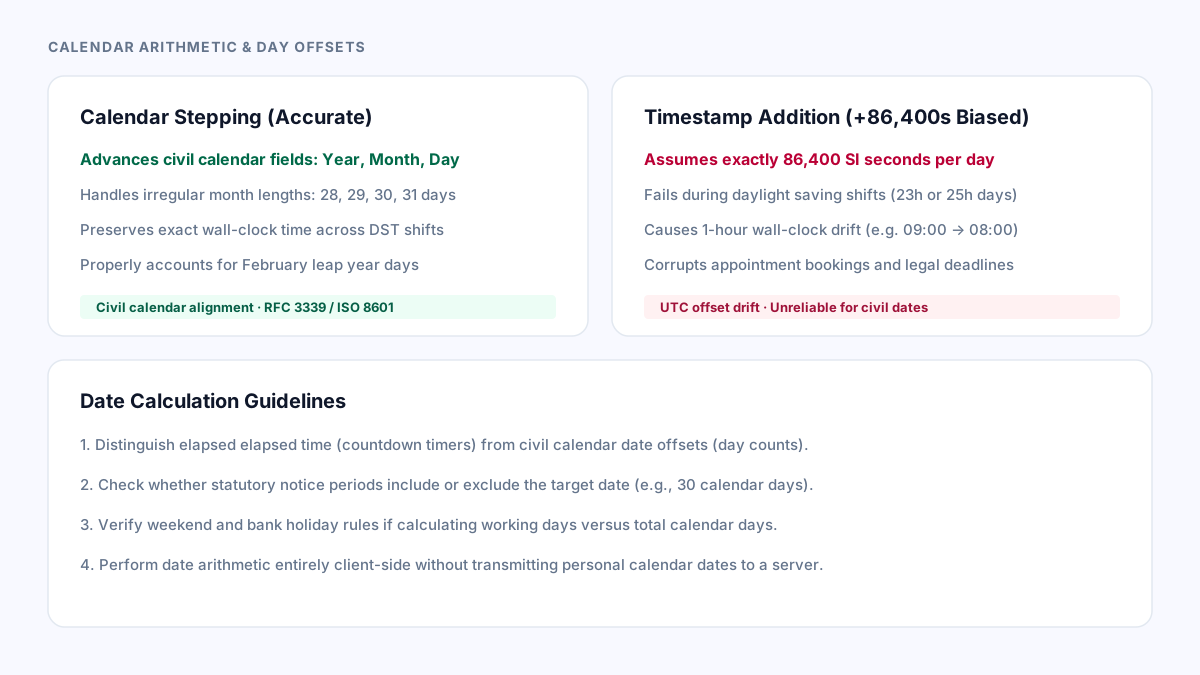
Civil calendar stepping vs 86,400-second timestamp addition
A common antipattern in software scheduling is calculating future dates by adding a fixed duration in milliseconds: date.getTime() + (days * 86400 * 1000). While this works across ordinary days, it fails when the calculated interval crosses a daylight saving time (DST) transition.
On the day clocks spring forward, a local civil day has only 23 hours (82,800 seconds); when clocks fall back, the day has 25 hours (90,000 seconds). Adding exactly 86,400 seconds across a DST boundary shifts the appointment or expiration by one hour (for example, moving a 09:00 deadline to 08:00 or 10:00).
To calculate accurate calendar dates, algorithms must perform calendar stepping: keeping the time component constant while advancing the year, month, and day fields in local civil time. PageUtil’s Days from Date uses genuine calendar arithmetic to ensure the resulting target date is mathematically exact.
Handling irregular month lengths and leap years
Civil calendar days vary in length from 28 to 31 days across months, with February introducing leap day variations (29 days in leap years). A year is a leap year if it is divisible by 4, except for century years not divisible by 400 (for example, 2000 was a leap year, but 1900 and 2100 are not).
When adding large numbers of days (such as 30, 60, or 90 days for statutory notice periods or contractual milestones), the offset calculation must iteratively roll over from month to month based on the specific days in each calendar month.
If you need to know the exact number of days that have elapsed between two existing dates, Date Difference calculates the total calendar days, elapsed weeks, and weekday context, ensuring you never miscount deadline spans.
// Robust calendar day addition in JavaScript
function addCalendarDays(year, month, day, daysToAdd) {
  // Month is 0-indexed in JS Date: 0 = January, 11 = December
  const date = new Date(year, month, day);
  date.setDate(date.getDate() + daysToAdd);
  return {
    year: date.getFullYear(),
    month: date.getMonth() + 1,
    day: date.getDate()
  };
}
Contractual deadlines: calendar days vs business days
In legal agreements, software service-level agreements (SLAs), and project management, it is crucial to clarify whether a deadline refers to calendar days or business days.
Calendar days count every consecutive 24-hour cycle, including weekends (Saturdays and Sundays) and statutory bank holidays. Business days exclude weekends and applicable national holidays, which varies significantly by jurisdiction and industry.
Unless a contract or court filing explicitly stipulates "business days" or "working days", deadlines typically default to calendar days. Always check whether the statutory rule includes or excludes the starting day (the "day of the act" is excluded in many legal jurisdictions).
| Scenario | Common Error | Standard Engineering Solution |
|---|---|---|
| Adding 30 days | Adding 30 * 86,400,000 ms | Step date.setDate(date.getDate() + 30) to preserve local clock |
| DST transition | 1-hour appointment drift | Perform civil date arithmetic rather than UTC epoch offset addition |
| End of month | March 31 + 1 month = May 1 | Validate target month length and cap day to last valid day of month |
| Leap year verification | year % 4 === 0 alone | Full rule: (year % 4 === 0 && year % 100 !== 0) || year % 400 === 0 |
| Deadline boundaries | Including starting day erroneously | Verify rule of law: usually exclusive of day 0, inclusive of day N |
Verification and timezone auditing
When establishing project roadmaps, visa validity periods, or warrant expiration dates, cross-check the calculated calendar day against your operating system calendar and local holiday observances.
Ensure that team members across distributed global timezones agree on the authoritative reference timezone (such as UTC or the jurisdiction where the contract is registered) to prevent day-offset discrepancies across international datelines.
All calculations on PageUtil execute locally inside your browser sandbox. Your personal schedules, birthdates, and project milestones are never uploaded or tracked.
References
Use the linked specifications and product documentation to check behavior in your own environment.
Continue troubleshooting
Related tools
Frequently asked questions
Why does adding 86,400 seconds sometimes change the hour of the day?
During daylight saving time changes, a local day has either 23 or 25 hours. Adding exactly 86,400 seconds causes a 1-hour drift. Proper calendar stepping avoids this by adjusting only the date field.
Does Days from Date include weekends in the calculation?
Yes. Days from Date counts standard civil calendar days, including Saturdays and Sundays, unless you separately adjust for business days.
How does the calculator handle February in leap years?
The underlying date engine follows the full Gregorian leap year rule, accurately allocating 29 days to February in leap years and 28 days in non-leap years.