Count addresses before choosing a prefix
The staff VLAN needs 70 devices now, room for 20 more and four infrastructure addresses including its gateway. That is 94 usable addresses. A /26 has 62 usable addresses and fails. A /25 has 126 and leaves 32 usable addresses beyond the planned 94.
For an ordinary IPv4 LAN, subtract the network and broadcast addresses from the block size. Count static addresses and reservations separately from the dynamic DHCP pool. Base guest capacity on concurrent devices and lease retention, since departed clients can still hold leases.
Place the largest subnet first
Start with 10.42.8.0/24. Allocate staff 10.42.8.0/25 (.1–.126 usable), guest 10.42.8.128/26 (.129–.190 usable, 56 required) and printers 10.42.8.192/27 (.193–.222 usable, 24 required). This leaves the aligned block 10.42.8.224/27 available.
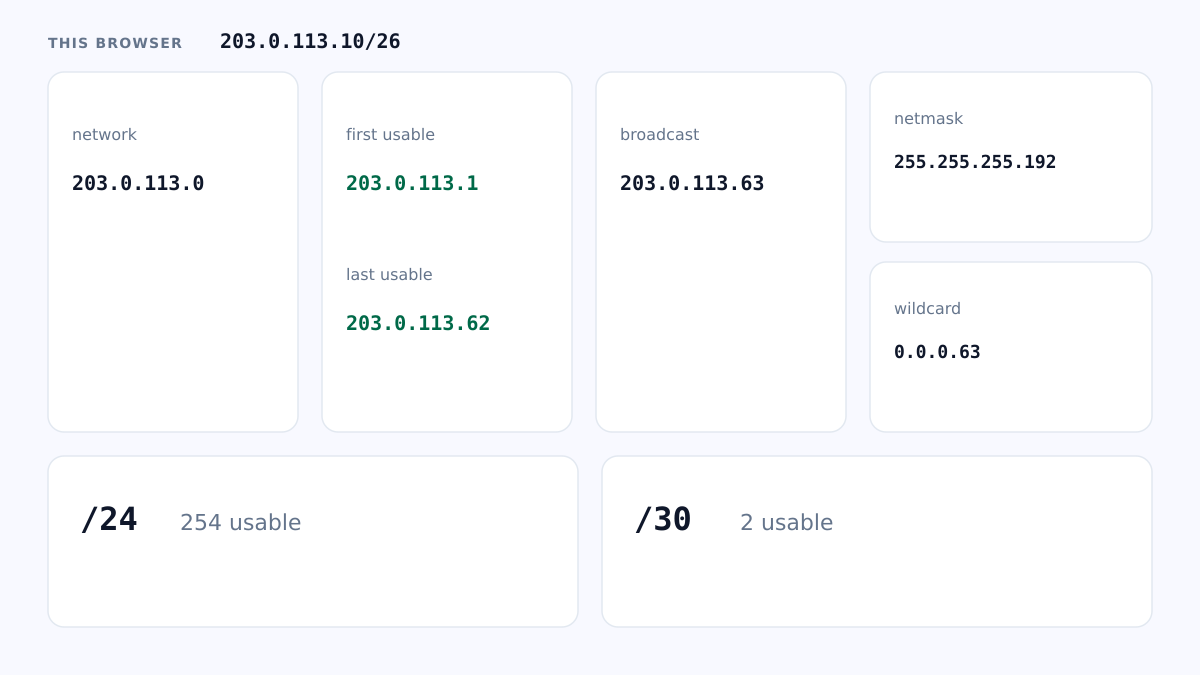
Enter each CIDR into CIDR Calculator and check the first and last usable addresses and broadcast. Check the ranges against each other and your existing allocations before assigning VLANs.
Download the branch-office address plan (CSV). Compare its ranges with the calculator, or replace the counts and CIDRs to document your own plan.
Translate the plan into DHCP settings
For staff, assign .1–.4 to infrastructure and make .5–.126 the dynamic pool if there are no further exclusions. That pool has 122 addresses for 90 planned clients. Verify the configured mask, gateway and DHCP scope on a test client in each VLAN.
Check for overlap with VPN peers and other routed sites. Hosted networks can reserve extra addresses. A /31 is for compatible point-to-point links and a /32 identifies one address. Neither uses the ordinary LAN capacity rule.
References
Continue troubleshooting
Related tools
Frequently asked questions
Why does a /26 fail for 94 devices and infrastructure addresses?
It provides only 62 usable addresses on an ordinary LAN.
Can I expand the staff /25 in place?
Expanding it to a /24 would consume the guest and printer blocks. Plan a separate block or a migration if that growth is likely.
Is the DHCP pool always the same as the usable range?
Infrastructure and static exclusions reduce the addresses available to dynamic clients.