What to run
Open URL Encoder. It stays in the browser.
How to read the result
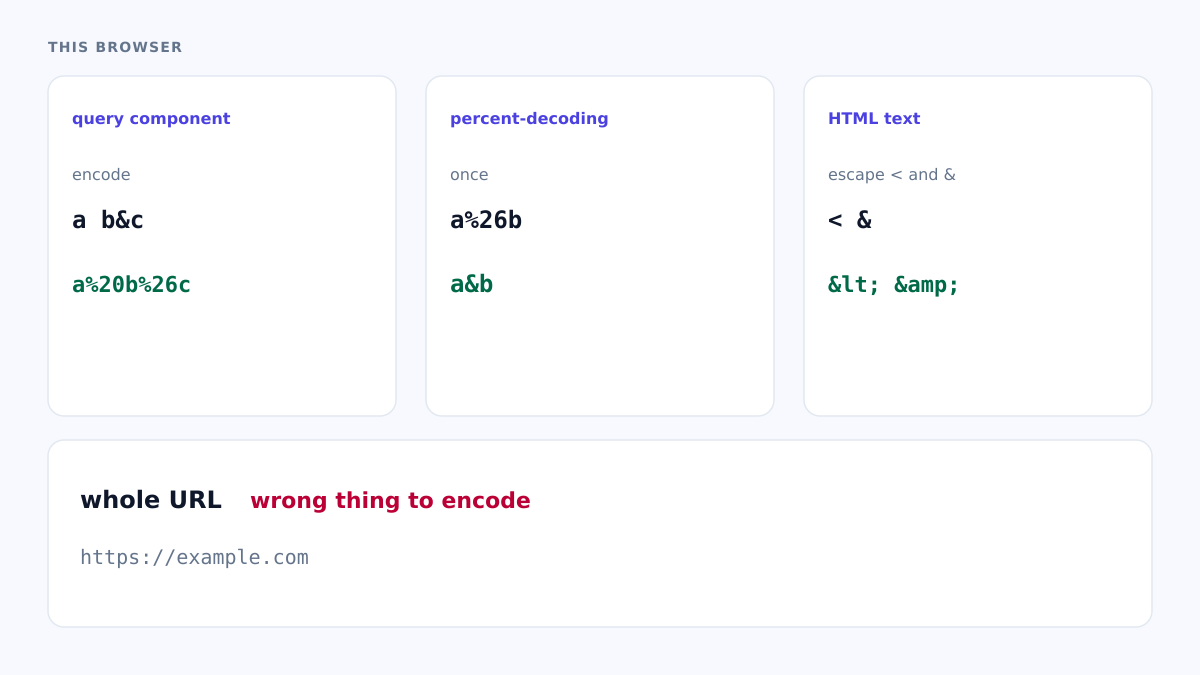
This tool uses encodeURIComponent: a space becomes %20 and a literal plus becomes %2B. Its decodeURIComponent operation leaves a raw plus unchanged.
Encode a component, not a whole URL, or you will escape ://.
The decoded form should match the input.
What to open next
Open HTML Escape only if the same string is also going into HTML. They are different encodings. It stays in the browser.
References
Related tools
Frequently asked questions
Should I encode an entire URL?
No. A whole URL is the wrong thing to encode. Encode a component, not a whole URL, or you will escape ://.
How does URL Encoder handle spaces?
This tool uses encodeURIComponent: a space becomes %20 and a literal plus becomes %2B. Its decodeURIComponent operation leaves a raw plus unchanged. URL Encoder stays in the browser.
Is URL encoding the same job as HTML escaping?
No. They are different encodings. Open HTML Escape only if the same string is also going into HTML.