What to run
Open UUID Generator. It stays in the browser.
How to read the result
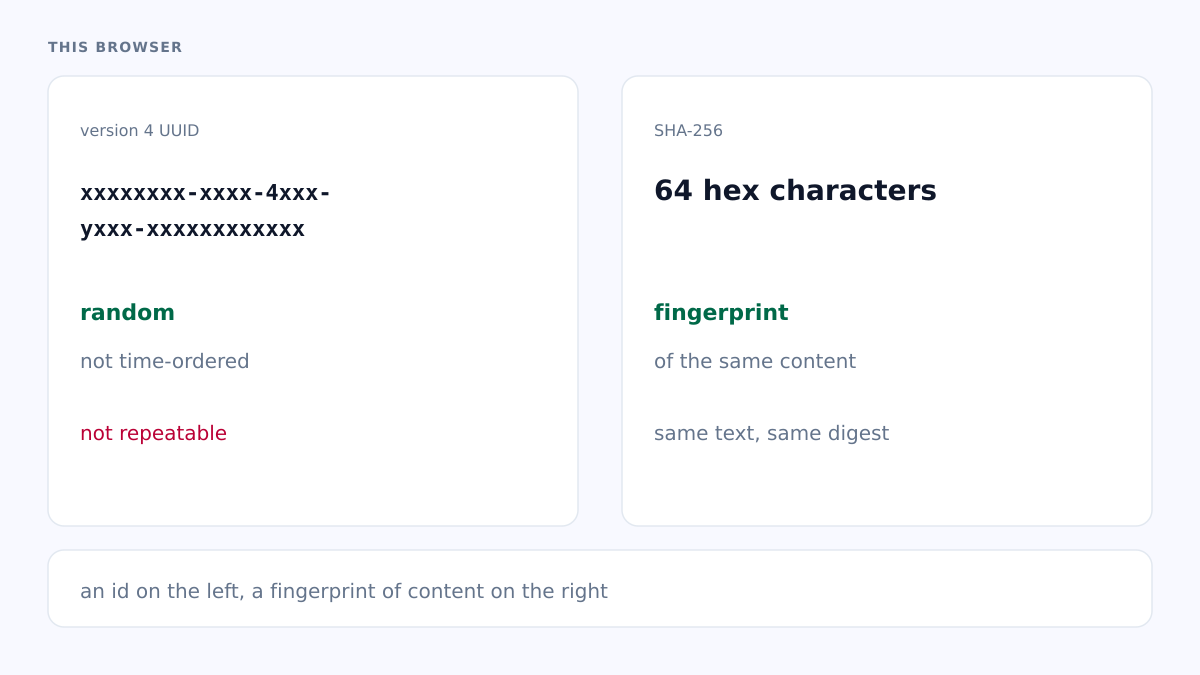
Version 4 means random, not time-ordered and not a hash of the content.
Hyphens are part of the canonical text.
Generating again will not reproduce the value.
What to open next
Open Hash Generator if you needed a fingerprint of content instead of an id. It stays in the browser.
References
Related tools
Frequently asked questions
Is a version 4 UUID time-ordered?
Version 4 means random, not time-ordered and not a hash of the content. A version 4 UUID is a random id.
Will generating a UUID again repeat the same value?
Generating again will not reproduce the value. Hyphens are part of the canonical text.
Is a version 4 UUID a SHA-256 fingerprint?
A version 4 UUID is a random id, and a SHA-256 digest is a fingerprint of the same content. Hash Generator stays in the browser.