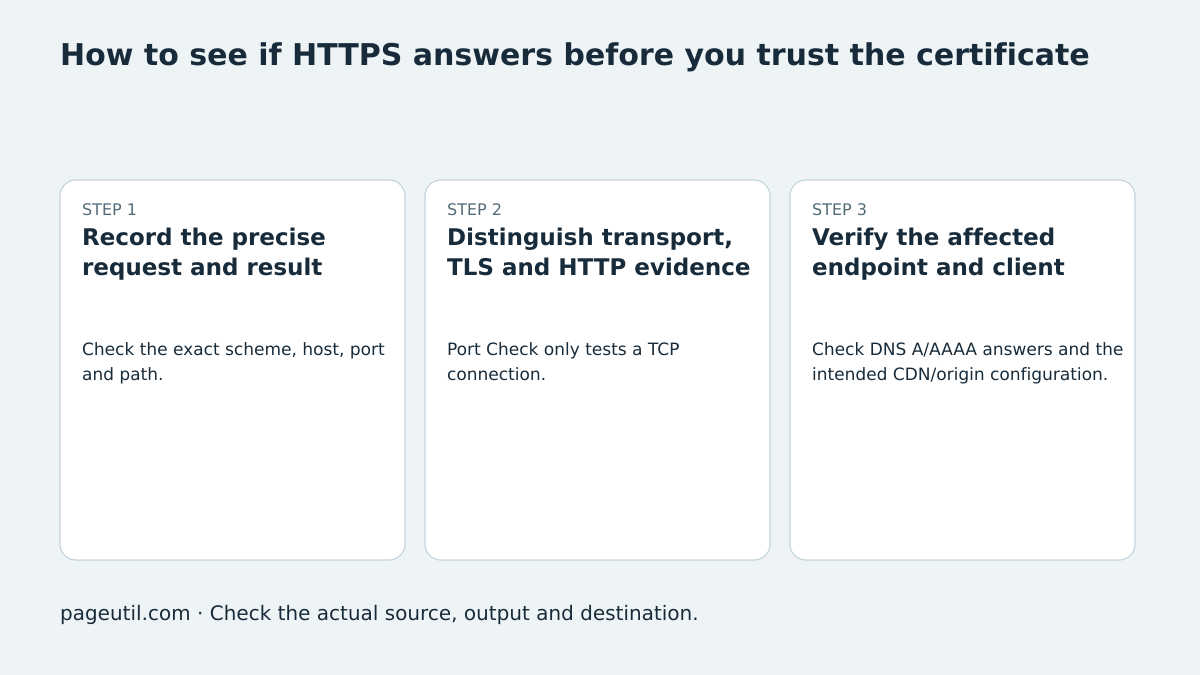
Record what the public hostname serves
Run SSL Expiry Checker against the exact hostname and port. Record the issuer and notAfter timestamp in UTC. The result reflects the peer reached by the Cloudflare probe. It is one observation and does not enumerate every backend or validate the whole TLS configuration.
Example: api.example.com serves a leaf certificate expiring 12 November 2026 at 09:00 UTC. The deployment record says the replacement expires 10 February 2027 at 09:00 UTC. The dates are illustrative. Identify the replacement by its SHA-256 fingerprint as well as its expiry.
Check each intended TLS listener with the hostname intact
Use DNS Lookup to inspect public A and AAAA answers. For infrastructure you manage, get the actual TLS termination targets from the load balancer or CDN configuration. DNS may expose only shared CDN addresses. Replace the documentation hostname and IP below with your own, and repeat for every reachable target from an authorised network.
In this example, 192.0.2.10 serves the February certificate while 192.0.2.11 still serves the November one. Both can pass trust checks before 12 November. Compare expiry and fingerprint against the deployment record to detect the stale listener.
# Bash. Stop if the handshake or trust checks fail.
leaf=$(openssl s_client -connect 192.0.2.10:443 \
  -servername api.example.com -verify_hostname api.example.com \
  -verify_return_error </dev/null) &&
  printf '%s\n' "$leaf" | openssl x509 -noout -enddate -sha256 -fingerprint
For an IPv6 address, enclose the address in brackets before the port. Use the trust store appropriate to the endpoint.
Correct the stale binding and verify through normal DNS
Check which certificate is bound to the hostname and port on the stale listener. Install or bind the intended leaf and intermediate chain, then apply the service's supported reload or rollout procedure. Where a CDN and origin both terminate TLS, verify them separately against their respective trust policies. An origin restricted to the CDN may require an internal test path and its configured CA.
Repeat the direct checks and confirm the intended fingerprint on each comparable listener. Then test the original HTTPS URL through normal DNS from the affected client network and confirm the expected application response. A valid certificate and a working application are separate observations.
References
Continue troubleshooting
Related tools
Frequently asked questions
Why can a renewed certificate still show the old expiry?
The serving process can still have the previous certificate loaded, or the hostname can reach a different TLS terminator.
Why specify the hostname when connecting to an IP?
SNI selects the virtual host. Hostname verification checks that the returned certificate covers the name clients use.
Can the CDN and origin legitimately serve different certificates?
Yes. They are separate TLS connections. Verify each certificate against the identity and trust policy for that connection.