What to run
Open Permutation & Combination Calculator in your browser to evaluate exact sample counts or generate combinatorial lists.
If you need exact mathematical counts, enter the total number of items n and the number of items to select r. If you are assembling phrases or keywords, paste your items directly into the List Generator tab separated by line breaks.
How to read the result
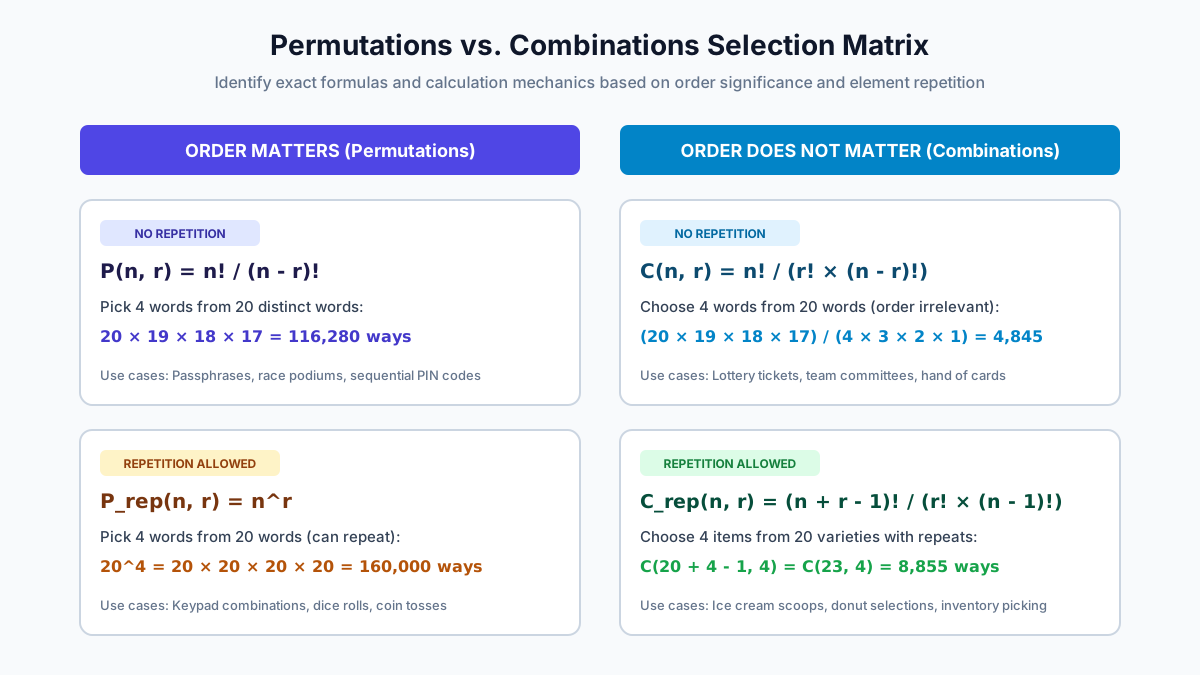
Examine the four fundamental combinatorics regimes. When picking 4 distinct items from 20 possibilities where order matters (such as sequential passphrases), there are 116,280 permutations (20 × 19 × 18 × 17). If items can repeat, the total increases to 160,000 (20^4).
When order does not matter (such as choosing lottery balls or committee members), combinations eliminate duplicate orderings. Picking 4 distinct items from 20 yields 4,845 combinations. If duplicate items are permitted, the stars-and-bars formula C(20 + 4 - 1, 4) produces 8,855 combinations.
What to open next
If you need to analyze the probability or statistical distribution of discrete outcomes, use Percentage Calculator to calculate relative ratios and rates.
If your generated items require cryptographic randomness or randomized sampling, proceed to Random Number to generate cryptographically seeded values.
Stop when
You have verified whether your system treats identical items in different positions as distinct outcomes.
Never attempt to render millions of combinatorial rows directly in browser memory without pagination or memory bounds, as large combinatorial explosions can exhaust client device resources.
References
Related tools
Frequently asked questions
What is the main difference between permutations and combinations?
Order matters in permutations, meaning the sequence 1-2-3 is distinct from 3-2-1. In combinations, order is irrelevant and both sequences represent the exact same group.
Why does repetition increase permutations from 116,280 to 160,000 for 4 from 20?
Without repetition, each choice reduces available options (20 × 19 × 18 × 17). With repetition allowed, every position has 20 possible choices, resulting in 20 to the 4th power.
How does the browser handle huge combinatorial results safely?
Calculations use native JavaScript BigInt for arbitrary precision arithmetic without float rounding, while list generation limits preview output to safe display thresholds to prevent DOM crashes.